CLICK ON PHOTOS TO ENLARGE....
Ok, back to food. We're gonna skate fast through this so as not to be even more boring than usual. I had written most of the Bologna food report yesterday, then, in one brilliant keystroke, I lost it all...I am certain it was Pulitzer-winning stuff, and had to start over.
So here is more, maybe all, of what I have to say about food in Bologna.
After my first pasta class, I headed directly to one of the only two places I'd eaten at in Bologna before this trip, a place simply called Serghei where I'd had a nice lunch back in 1997 or '98 when I jumped off the train to Florence just to have that one lunch in Bologna.
 |
| Trattoria Serghei, Bologna |
Serghei is the consummate family run
trattoria with sister in the kitchen, brother running the front and someone's mother in the kitchen to help from time to time. They don't do fru fru, but stick with the standards of Bolognese cuisine. The sister is skinny and cute, Silvanio, the brother, is a frustrated electric guitarist whose replica of a Fender amp from the early '60s resides in the hall to the bathroom.
I had a pleasant lunch that Monday, so much that I reserved a spot for that very night for a return visit...he told me they were having one of my favorite dishes,
maiale al latte—pork roasted in milk—which is something you don't see often in restaurants and I wanted to see how theirs compared to mine.
 |
| Gramigna al Sugo di Salsiccia, Serghei, Bologna |
So here is the rundown of the dishes I sampled on those two visits. First, I had a yummy pasta,
gramigna al sugo di salsiccia (
gramigna=bermuda grass,
salsciccia=sausage)—the pasta is slightly thick and chewy, but not too much, and the
sugo, or sauce was the perfect condiment, somewhat hearty on both counts. And as such, a bit counter to the idea of Bologna's food that I had in my head, but this is why I wanted to spend more than a couple of hours eating in the foodie (whatever that is) paradise.
That night I opted for two pastas (!) and a meat course. I had to try their
tortellini in brodo so that, by the end of the trip, I would have at least three or four versions of this classic under by belt—oh, so literally that!
 |
| Tortellini In Brodo, Serghei, Bologna |
The
tortellini—which are typically stuffed with a finely ground mixture of pork, mortadella, maybe some prosciutto, eggs, cheese and nutmeg—were tasty and the broth, or brodo, was great, though it didn't quite match that depth achieved by Trattoria Anna Maria the night before. Still, a solid "A" rating.
My next choice—again, this is all for science you understand—was Serghei's version of tagliatelli al ragù, that anchor of Bolognese cooking. I enjoyed this dish very much, but, again, compared to Anna Maria's incredibly thin and light pasta, this one paled just a tad. The pasta was only slightly heavier, and if I had never had the other, this would be a standard by which to judge. So, if in Bologna, definitely put Serghei on your short list.
 |
| Tagliatelle al Ragù, Serghei, Bologna |
I enjoyed Serghei especially for its family-run feeling, lack of pretense and honesty of the cooking and the presentation. No frills, just like me!
To top off these light starters!!!! I ordered the coveted
maiale al latte. Coveted? No, greatly desired...is that the same. Anyway, Yum! it was delicious. The idea is to slow-roast the loin, shoulder, or whatever in about a liter of milk to keep the meat moist, and to add some flavor. As the milk cooks and reduces, what is left is an absolute treat. The solids, very full of sugar, caramelize into clumpy curds which are imbued with porky goodness.
I've made this dish many times, but have always wondered how mine compared to the home office's version. Well, I think I do pretty well. The pork in the USA is leaner, more flavorless and just more blah, so it's hard to exactly reach the same heights, but lately I've been using shoulder or butt, both of which have more fat than loin, and thus more flavor, and more moisture in the meat.
 |
| Maiale al Latte, Pork Roasted in Milk, Serghei, Bologna |
I wish we had better pork more readily available. I will say that lately I've been using a nice pork in Portland from a small producer who finishes off the pigs with a diet of hazelnuts—NO, they don't choke them with nuts—which gives the meat more flavor, and, the breed they use is much fattier than supermarket pork. I'm sold even though it considerably more expensive. Once in a while, it is worth it. I know there are similar producers near Austin, just don't know who they are.
The next day I was on a hunt for a good version of the classic Bologna veal chop called
cotoletta bolognese, and a couple of books directed me to the All'Osteria Bottega. So I trucked over after class and plunked my tired ass down in a chair in this comfy, but a tad "stuffy", place not far from my hotel. But I could tell they did things correctly and my mouth began watering as soon as I licked some stains on the menu. Wait, I didn't actually do that, except in my head!
One of the disappearing treasures of the Emilia (Bologna, Parma, Modena, etc) kitchen is called
culatello, which literally translates as "little ass". What it actually is, well, it's the prime ass cheek of these wonderful, whey-fed piggies. It's the "filet" of the
prosciutto, the very best part, and it's expensive as hell because to "harvest" one, you destroy a whole
prosciutto, or ham. Plus, to make it the traditional way, you have to cure it in a moldy, earthy room full of the right bacteria which provide the taste of a true culatello. Well, the assholes who are trying to make Europe a perfect ONE, have decided that all meats must be cured in rooms with white tiles which can be washed down periodically with a hose and water. Screw the
culatello, they say! (Well, someone should screw THEM in their little asses, in my opinion.) Well, somehow these diamonds of porkiness are still being produced, and they are still quite good if you search out the artisanal producers.
 |
| Tagliatelle al Culatello, All'Osteria Bottega, Bologna |
All this is leading up to the pasta choice I made at Bottega:
talgliatelle al culatello, basically delicate fettuccine (
tagliatelle) topped with a healthy portion of lightly sauteed, perfect pig's ass,
culatello. No secret blend of herbs or spices, just
culatello, some butter or olive oil, and nothing else to get in the way of the pure taste of the perfectly cured pork...an absolute delight, for sure. Can't get this at home!
And I will want more soon! What to do???
Well, the focus of this day's meal was the
cotoletta, veal chop, and I was in for a celebration of animal fats without really knowing it. The thin chop, bone attached, was lightly sauteed in butter, then topped with a few thin slices of prosciutto, then "broiled" with a generous amount of Parmigiano on top, and then left to swim in butter. Crapola! It was great, but so, so, so, so, so rich.
 |
| Cotoletta Bolognese, All'Osteria Bottega, Bologn |
You can see the pool of butter in this photo. Click to enlarge it for a better look at what will surely add greatly to my risk of death by heart failure.
Somehow, that same day, I was able to eat again. This time at the other place I'd been to for one of those "express" lunches, this one was in 2007.
Trattoria Giginia is another of the stalwarts of true
Cucina Bolognese, and I was very impressed on my first visit. So, along with my friend Cosimo and his always-attached wet towel, I went back to sample even more goodies from their menu.
 |
| Trattoria Giginia, Bologna |
I had to have
passatelli again, and was interested to see if Giginia's
brodo could meet the standard set by Anna Maria. Well, the answer is no. But it was close, and, again, if you never had the very, very best, then this one would have possibly earned that title. But not now. I've been spoiled.
 |
| Passatelli In Brodo, Trattoria Giginia, Bologna |
 |
| Spuma di Mortadella, Baloney Mousse, Trat. Giginia, Bologna |
Oh, wait, we had some appetizers too, including
spuma di mortadella which I call "baloney mousse" which is more or less what it is. Puree some
mortadella, add some finely minced sauteed onion, a bit of reduced broth since
mortadella, about 40% fat, isn't already rich enough, then a sizable amount of whipped cream, again, because forty percent just isn't rich enough, then chill in a mold, and serve with bread or toast points. Really good, this stuff, and Giginia's version is quite luxurious, but then, anything with this high a fat content could only be so.
Well, the next day after my pasta class I decided to try out a place I'd heard prepared a good
tortelloni alla zucca—pasta stuffed with winter squash—and that the best way to have it was not with the more common butter and sage, but with
ragù. So I headed toward the stangely named Trattoria dal Biassonot which was about two doors down from Serghei. Apparently Biassonot is some symbol of night spirits in Bologna and takes the form of a black cat.
 |
| Trattoria dal Biassonot, Bologna |
I walked in just before lunch was over and grabbed a table. Since I was by then on a quest to try every version of tortellini in brodo, guess what I ordered? I knew that the chef/owner was a master pasta maker, having won a Matterello d'Oro a few years ago, I was certain that Biassonot's offering would be among the best. And it certainly was. Flavorful stuffing with hints of the individual components, yet still blending into a unique, unified entity into itself. And, of course, the pasta wrapping on these tiny packages was properly transparent and light. I was impressed. As usual, the broth was excellent, but still didn't reach the heights of Anna Maria's. But didn't I say it was excellent on its own?
 |
| Tortellini In Brodo, Trattoria dal Biassonot, Bologna |
So, for my next course, I sampled the recommended
tortelloni alla zucca with the standard ragù bolognese. They were fine, but I like my version a tad better. I grind
amaretti cookies into the filling, and overall, the flavor of the stuffing of mine is more pronounced. But my version comes from a different place, a few miles up the road, and the folks in Bologna would snicker at mine. Oh well.
 |
| Tortelloni alla Zucca, Trattoria dal Biassonot, Bologna |
After the meal was finished, the owner came out and spoke with me. She knew about my pasta course because I had mentioned it in an emailed reservation request I'd sent the night before. She knew it was me when she saw me. Guess it's the brother/sisterhood of
sfoglini (bolognese pasta makers) that allowed her to recognize me???!!! We spoke for a while about my classes, her pastas, and food in Bologna in general. She even pulled out her great, great grandmother's
mattarello which she held carefully and proudly while mentioning that she almost never uses it because she doesn't want to damage it!
After we traded food secrets, I asked if she knew where I could get some great
parmigiano reggiano, and of course she did, right around the corner. (I bought two kilos of 3-year old cheese there!) And then one more request, this time for a source for one of my favorite after dinner drinks, and a specialty of Emilia Romagna,
nocino, which is an infusion in alcohol of green walnuts picked in late June on St. John's day, the 24th. After a few months, probably in October, the walnuts are removed and a simple sugar syrup is added and then the stuff is left to age until about Christmas. The taste is strong and an acquired on for sure...most people don't like it, but for some reason I find it delicious.
 |
| Nocino, Green Walnut Liqueur, Trattoria dal Biassonot, Bologna |
Well, she replied that she could sell me a bottle of artisanally produced
nocino, and she offered me a generous sample. Needless to say, I bought a bottle.
I guess it was that night, or the night after, I tried another joint that came highly recommended. Trattoria Gianni. It was fine, the food good, but somehow the vibe bothered me. I had a nice
tagliattele, but this time with a lamb ragù instead of the beef/pork version. Good.
 |
| Stinco di Maiale, Pig Shank, Trattoria Gianni, Bologna |
For my second course, I had something I'd been looking for since Florence, an oven roasted pork shank, the
stinco di maiale. It was very well done, nicely browned outside, and very moist inside. But it was so rich, I could not finish it. Maybe because I had an appetizer, Gianni's nice version of
spuma di mortadella. Well done.
 |
| Spuma di Mortadella, Trattoria Gianni, Bologna |
 |
| Lasagne Bolognese, Trattoria dal Biassonot, Bologna |
And at that point, I was about to pop!
Let's see, I tried to go back to Serghei for my last lunch in Bologna, but somehow got there too late. So, instead, I went next door to Biassonot for another hit of pasta. Duh.
Since I had already had her past in broth, and I had yet to try the quintessential Bolognese baked pasta, the famous
lasagne. Ok, time to break another stereotype, this time of
lasagne being a heavy dish laden with lots of cheese and meat and
al dente pasta. Well, the primary source of Italian-American recipes is southern Italy (and we will mistakenly include Sicily in this geographic chunk) where the food does tend to be a bit heavier than in the north.
Lasagne there is often, maybe normally made with a semolina-based dried pasta, the same you can buy at any American supermarket. The result, combined with the more southern fillings of ricotta, mozzarella, etcetera is a globby, heavy mess, and the kind I grew up with.
In Bologna, things are different. The dish is made with fresh egg pasta, never dried semolina pasta. And the pasta most often employed is made with spinach, thus the
lasagne (
lasagne is plural,
lasagna is singular…one rarely eats ONE
lasagna; just trying to keep things straight here!)—thus, the
sfoglia used to make the lasagna is green,
verde. And instead of ricotta as a filler, a very light schmear of white sauce (béchamel) is utilized to help bind the casserole (god, i hate to use that word here, but it fits, I suppose) together. A tiny among of
ragù is used for substance between the layers, and a dusting of
parmagiano reggiano completes each stratum. The first time I made
lasagne in this way, I was shocked at how light and delicious it was. So different from my mother's, or any I had ever had at any American Italian place. It almost seemed like meeting an old friend, and I can't say why that is, but it immediately became my
lasagne standard, though I still gobbled plenty of the other style when I visited the folks.
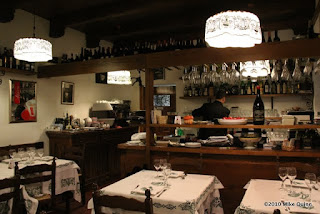 |
| Trattoria dal Biassonot, Bologna |
Biassonot's
lasagne was exemplary (damn, this is confusing...the actual dish is plural, but talking about A dish in the plural seems odd, so sorry for any inconsistencies. Almost airy in its lightness, a few nuggets of ground meat showed up here and there, and the sum total of all the parts made me a very happy, ballooning gastronome (not sure I really qualify for that, I might want to stick with chowhound).
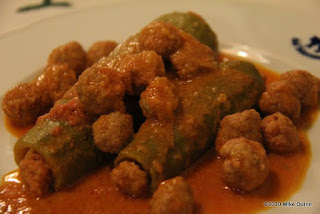 |
| Zucchini Ripieni, Stuffed Zucchini, Trattoria dal Biassonot, Bologna |
For my "main" course, as if anything could take the spotlight off that serving of lasagna, I opted for another traditional dish, stuffed (
ripieni) zucchini. The squash is hollowed out and filled with a meat mixture that is basically used for meatballs as well. In fact, the plate was dotted with a few tiny meatballs, a nice little touch, and the whole thing was bathed in tasty, light tomato sauce. I was very pleased with this home-style dish which I understand is now rarely served in restaurants. Lucky me to find a place that still does. (Actually, so does Serghei, and I wanted to try theirs during this lunch, but that was not to be, so it was cool Biassonot served it as well.)
[As I write this, I am on a train heading from Alba to Milan, the first stage of my journey back home. I'll overnight in Milan, then up early for the flight Sunday morning to JFK. I'll hang out in NYC for a few days visiting pals and eating lots of great Chinese food. Stay tuned for that!]
 |
| Tortellini In Brodo, Trattoria Anna Maria, Bologna |
Ok, before we all explode, let's return to where we started, to Trattoria Anna Maria. Like I said, I'd been jonesin' for that broth all week and just had to get back for one more hit. This time, I went with the
tortellini, my, what, fourth of the week? Third? I've lost count. As expected, the
brodo was exceptional and managed to easily maintain its place as number one in my book. The
tortellini themselves, at this point, were almost secondary, but were sensational as well. I'm so glad I decided to return.
For a change of pace, my other pasta on this visit was still her hand-rolled stuff, but this time cut a bit thicker into what are called
pappardelle, not as wide as in Tuscany, but definitely wider than the
tagliatelle. I was chided in my pasta class, when I was learning to cut
tagliatelle with a knife, for cutting them about an eighth of an inch too wide. "Those are
papparedelle! Not
tagliatelle!" Ok, so now I know. The condiment consisted of sauteed mushrooms, but I am not sure what kind. Porcini were out of season by this time, but whatever they were, they were perfect.
 |
| Pappardelle ai Funghi, Noodles with Mushrooms, Trattoria Anna Maria, Bologna |
Try it at home: get a variety of mushrooms—crimini, white, shitake, whatever you can find—chop them very coarsely, then, heat a bit of oil in a pan, not too hot, and had a tiny bit of chopped garlic, then the mushrooms…low heat, please…maybe splash in a half cup or so of dry white wine and let it evaporate. Then maybe a tiny bit of chicken stock or broth and let the pan cook on very low heat until the mushrooms are very soft and tender. Check for salt and pepper, add a bit of freshly chopped Italian parsley (with 3-4 mint leaves if you have them). You will add this to your cooked pasta. If the sauce seems too dry, add at least one-quarter cup of olive oil…more if you can deal with it. Serve with generous sprinklings of
parmagiano reggiano…freshly grated, please!!!!
Ok, with that little "
regalo", I'm gonna close out this hot-winded account of my eating adventures in Bologna.
Hungry yet?
Next stop, Montalcino in southern Tuscany. My personal paradise and where my will stipulates that my ashes are to be scattered when that becomes necessary. Yes, I love the place.


 Ok, the dish I love at il Pozzo is called pinci al olio, aglio e peperoncini. Pinci are the local version of "spaghetti", but they are hand rolled in the way we used to roll out snakes with clay in kindergarten. So the sign of a true handmade version is the irregularity of the rolling. One four or five inch snake will be thick, thin, thicker again, then thin. And they are a bit chewy, but not hard like al dente pasta, just chewy. They are a foil for a wonderful olive oil dressing which is spiked with lots of garlic and a little hot pepper. Absolutely perfect dish, and il Pozzo's version of the pasta is the best I've had. Anna's is good, but still comes in second!


